

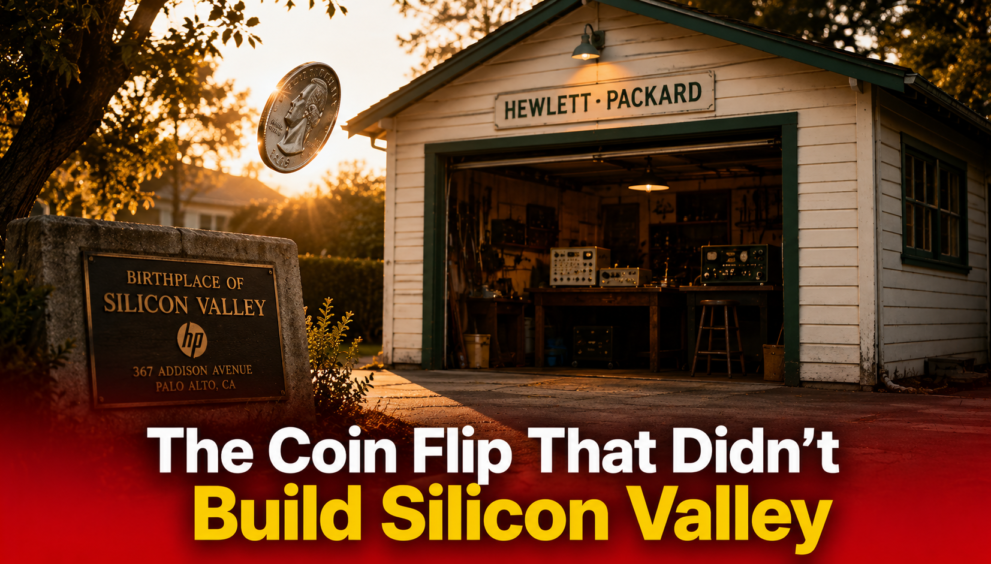
You’ve probably heard the version where Bill Hewlett and Dave Packard flipped a coin to decide where to start their company, and that’s supposedly how Palo Alto became the birthplace of Silicon Valley instead of, say, the East Coast. It’s a great story. It’s also not what happened.
Here’s the real sequence, and the version most people never hear.
A shed, an apartment, and a dean who wouldn’t let them leave
Hewlett and Packard met at Stanford in the early 1930s, both electrical engineering students. By 1937, they were having serious conversations about starting something together. The problem was that good engineering jobs, real jobs with real salaries, mostly existed back east. Companies like RCA and General Electric were where ambitious young engineers were supposed to go.
The person who changed that calculation was Frederick Terman, Stanford’s Dean of Engineering. Terman had a theory that Californian graduates kept leaving because there was nothing local to keep them, and he actively pushed his best students to build companies in the area instead of shipping out. Hewlett and Packard were exactly the kind of students he meant. Terman more or less talked them into staying.
So the location wasn’t a coin flip. It was one professor’s deliberate campaign to stop California’s engineering talent from draining east, years before anyone called the area Silicon Valley.
By 1938, Packard and his new wife, Lucile, had moved into the ground-floor apartment at 367 Addison Avenue in Palo Alto. Hewlett, meanwhile, was sleeping in the shed out back. Their combined starting capital was $538, roughly the price of a used car at the time. Some of that went toward a secondhand Craftsman drill press.
Read this later: What Is AI Distillation? The Hidden Way Your Business Data Trains AI
So what was the coin actually for?
The flip happened in 1939, once they were ready to formally register the partnership. The real question on the table wasn’t geography. It was whose name would go first on the letterhead: Hewlett-Packard or Packard-Hewlett. Hewlett won the toss, which is the only reason the company isn’t called PH instead of HP.
It’s a small distinction, but it matters because the popular version turns a naming formality into a heroic gamble that supposedly decided the fate of an entire region. In reality, the geography was already settled. The coin only ever touched the order of two last names.
Read this later: What Is AI Distillation? The Hidden Way Your Business Data Trains AI
The oscillator that got them noticed
Their first real product was the HP 200A, an audio oscillator, a device used to test sound equipment. Competing models on the market cost around $200. Hewlett’s design used something almost comically simple: a small incandescent light bulb, wired in as a temperature-sensitive resistor to stabilize the circuit. It let them sell the 200A for $54.40, a fraction of the competition’s price, using off-the-shelf parts most companies would have considered beneath a serious engineering product.
Walt Disney Studios became an early customer, buying eight modified units of the follow-up model to help mix the soundtrack for Fantasia. A company that started with $538 and a light bulb trick was already, within a year or two, contributing to one of the most technically ambitious films of its era.
You might want to see this short clip
Why the coin-flip version survives anyway
The garage at 367 Addison is now a California Historical Landmark, officially preserved as the “Birthplace of Silicon Valley.” Tour it today, and you’ll hear the coin flip story told exactly the way most people already know it, minus the correction about what the coin was actually deciding.
It’s easy to see why the wrong version wins. “Two engineers gambled everything on a coin toss” is a better opening line than “A Stanford dean ran a quiet recruitment campaign to keep talent from leaving the state. One is a legend. The other is just how institutions actually shape industries, slowly, deliberately, and almost always without anyone flipping anything.
Read this later: Motorola Finally Fixed Its Phones. It Still Hasn’t Fixed This.